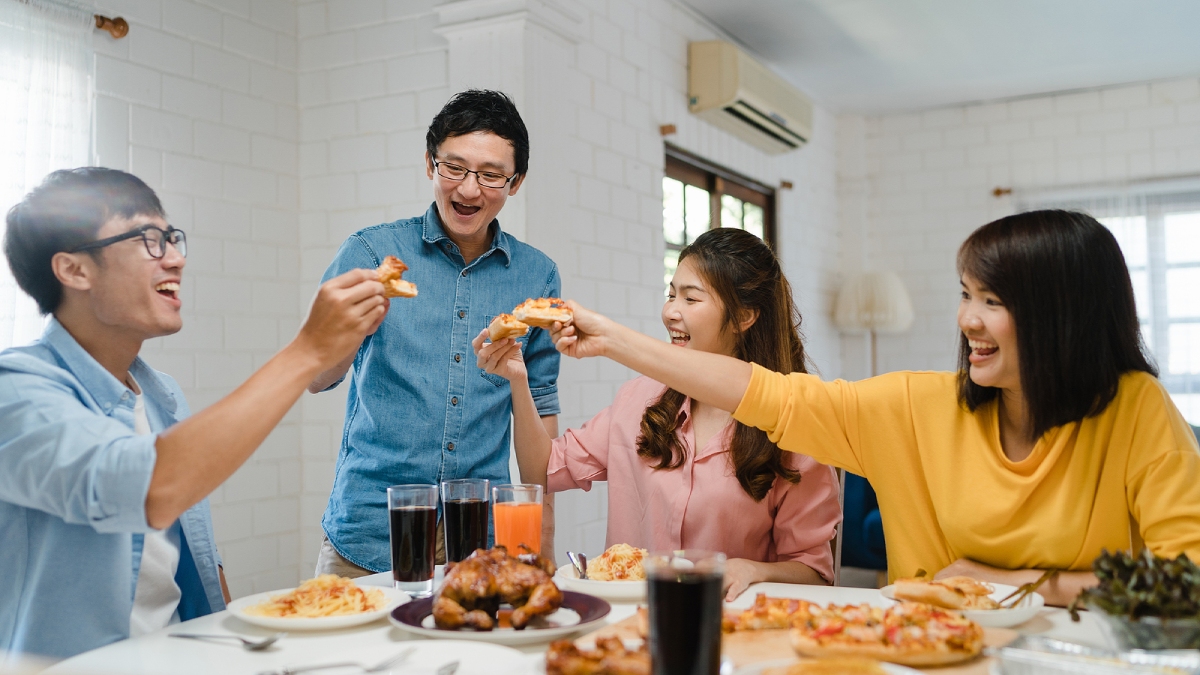
Something shifts at a Singaporean gathering the moment food lands on the table. Conversation loosens, chairs get dragged closer and the person hovering near the door is suddenly handed a plate and told to eat first. Nobody plans this. It happens at weddings and housewarmings, at birthdays and farewells, and at any gathering where flags of a different sort appear, the ones made of foil balloons and a banner someone taped up crookedly an hour before.
Celebration here rarely takes the shape of a formal event with a seating plan. It looks like a folding table set up in a void deck, or twelve people crowded around a kitchen counter waiting for someone to finally bring out dessert. Whatever the occasion happens to be, the celebration happens over a spread that four different households contributed to, where everyone argues cheerfully about who made the best dish.
Food does the talking in a country of many languages
Singapore holds several cultures and faiths within a very small space, along with a fair number of languages. Food became the common ground because it had to. You do not need to share a mother tongue with a neighbour to accept a plate from them, and no speech is required to signal goodwill once you have turned up carrying a tray.
The habit runs deeper than convenience. Offering food is how care gets expressed in households where affection is not usually spoken aloud. A parent who never says the words will still cut fruit and leave it where you will find it. Plenty of people here grew up understanding that food is our love language, even without ever putting the phrase to it.
Sharing also asks for a kind of thoughtfulness that formal hosting sometimes skips. A spread meant for a mixed crowd has to account for halal requirements as well as the aunt who eats vegetarian and the child who will only touch something plain. Getting that right is a quiet form of respect, and regular hosts plan for it without any fuss.
Ordering has become the easy part. You can browse our online cake shop in Singapore and arrange delivery to arrive before the guests do, or drop into one of our physical outlets and pick something up on the way over.
The void deck spread and the potluck instinct
Ask people to picture a celebration and many will describe a block party before they mention anything more elaborate. Trestle tables under an HDB block, a borrowed rice cooker plugged into a wall socket and paper plates weighed down against the wind. Residents committees organise plenty of these, though the memorable ones tend to assemble themselves.
The potluck instinct comes from an older way of living. Kampung households cooked with the door open and portions that assumed visitors, and that assumption travelled upwards into flats. A curry made for six somehow feeds nine. Extra food gets treated as sensible planning instead of a miscalculation.
What makes a void deck gathering work is that nobody carries the whole thing alone. One family brings noodles, another arrives with satay from a stall down the road and someone always turns up with a box of pastries because the day got away from them. Nobody minds. The point of that table is that several hands built it.
Home dinners with the television murmuring away
Not every celebration happens downstairs. Plenty of families mark an occasion at home with something running in the background, half watched and fully heard. Somebody comments on it, and somebody else insists that whatever it is used to be better years ago.
These dinners tend to follow their own small rituals:
- The dishes that only appear on occasions, cooked by whoever in the family has the best hand for them
- A late arrival who gets fed regardless of how long the food has been sitting out
- Dessert brought out well after everyone has claimed to be completely full
Home gatherings often collect three generations into one room, which gives the food a little more weight than usual. Grandparents remember versions of a story that younger relatives have only heard secondhand. The meal becomes the place where those accounts meet, usually without anyone naming it.
One cake, and suddenly the whole room is family
One particular moment repeats itself at almost every Singaporean celebration. Someone brings out a cake, the room rearranges itself around it and the phones come up automatically. Cutting a cake remains one of the few gestures that still gets a whole room to stop and look in the same direction.
A shared cake does something a plated dessert cannot. It has to be divided and passed along, so the person you barely know at the far end of the table ends up receiving a slice from your hand. Icing colours change with the occasion and the candles come in different numbers, but the gesture stays identical whether the room is marking a first birthday, a retirement or a house that finally got its keys.
Bringing something along
If you have been invited somewhere and asked to bring a little something, a few things travel better than others. Choose items that survive a walk across a car park and hold up in the heat. Portion them so that they divide easily without a knife, and lean towards something that suits a mixed crowd instead of a narrow taste. Pastries and sliced cakes handle all of this comfortably, which is why they appear on so many tables.
Conclusion
Celebrations here have never been about elaborate hosting. They are about turning up and filling the table together, then making sure the last person through the door gets fed. That is a habit Singapore has held on to through decades of change, and it shows up at every gathering without anyone needing a reminder.
If you are putting together a celebration of your own, let Polar Puffs & Cakes help you fill the table. Explore our range of puffs, pastries, cakes and more, whether you need a celebration cake for the moment everyone crowds around or boxes of savoury bites to carry along to a gathering you were invited to at the last minute.